

The release of Citrix Virtual Apps and Desktops (CVAD) 2603 represents a meaningful shift in how HDX approaches graphics optimization. HDX graphics super resolution upscaling, available as a Tech Preview since 2507 and now fully supported in 2603, is one of the first examples of a broader move toward adaptive graphics optimization within HDX.
Historically, delivering high-quality graphical experiences in virtual environments required a careful balance of graphics policies, bandwidth considerations, endpoint capabilities, and, in some cases, significant investment in server-side GPU resources. HDX graphics super resolution upscaling introduces a different approach. By leveraging supported endpoint GPUs to reconstruct transient content after transmission, it reduces the amount of data that must traverse the network while maintaining the responsiveness and image quality users expect.
More importantly, the feature reflects a broader evolution within HDX. Rather than relying solely on static administrator-defined policies, graphics optimization is becoming increasingly adaptive, allowing the protocol to respond dynamically to endpoint capabilities and real-time network conditions.
The Challenge of Transient Content
Citrix HDX has historically excelled at delivering traditional enterprise applications dominated by static content (text menus, forms, and standard user interface controls) that can be delivered efficiently with remarkably low bandwidth consumption while maintaining a responsive user experience.
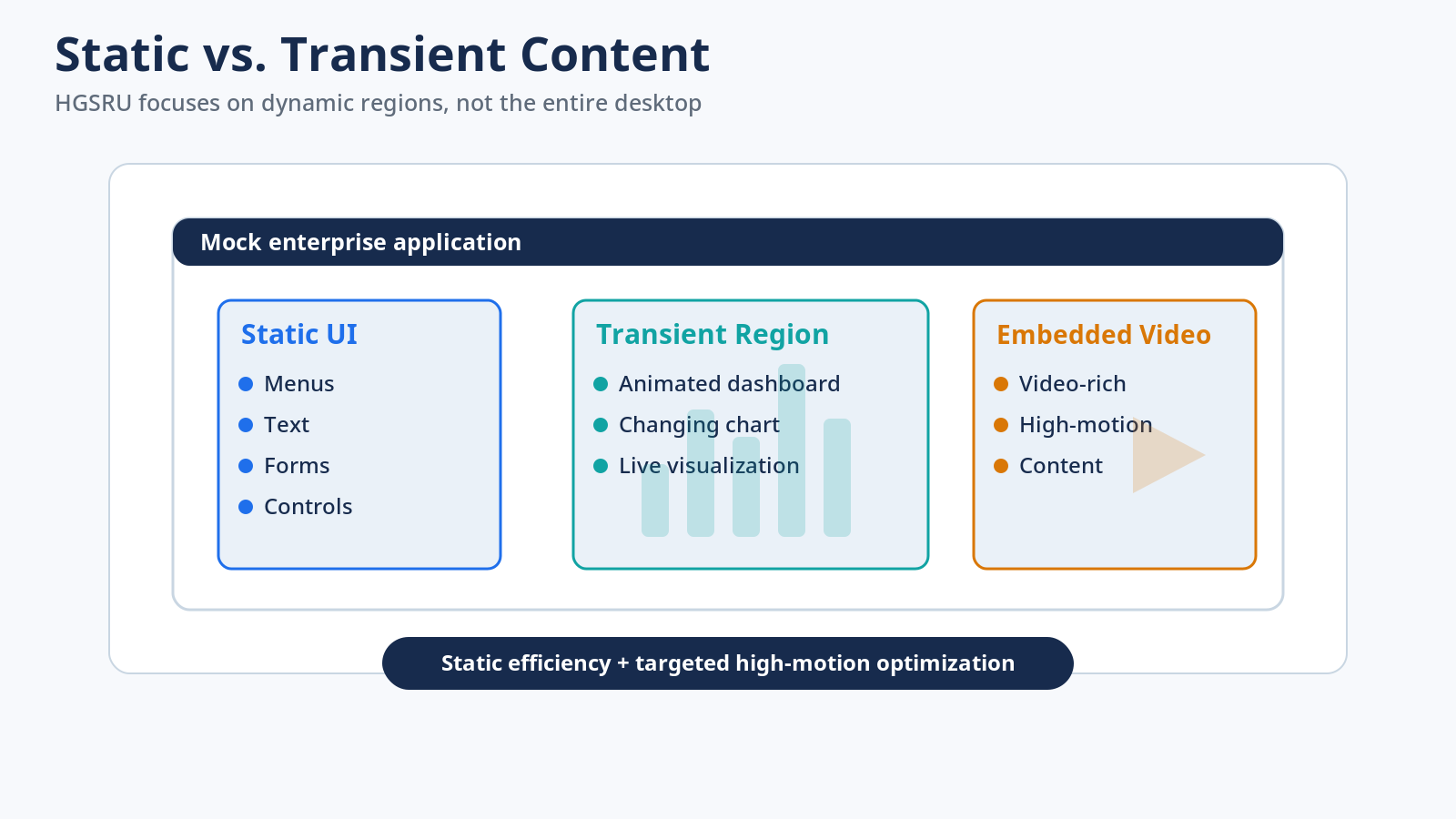
Today, modern applications include increasingly dynamic graphics rendering and are moving away from static interfaces. They frequently combine traditional business applications with embedded multimedia, real-time visualization, and dynamically rendered content. From an HDX perspective, these regions are commonly referred to as transient content areas on the display that experience rapid frame changes over time.
Transient content introduces a unique challenge for any remoting protocol, as static portions of the desktop can be efficiently compressed and transmitted; however, rapidly changing regions require significantly more processing and bandwidth to maintain acceptable frame rates and image quality.
In many environments, this challenge has historically been addressed via a combination of HDX graphics policies, server-side GPU acceleration, and careful tuning of image quality settings. The challenge becomes even more pronounced when transient content exists alongside traditional application interfaces. Rather than remoting an entire desktop as video, the protocol must intelligently balance image quality, frame rate, bandwidth consumption, and user responsiveness across different regions of the screen simultaneously.
Technologies such as Browser Content Redirection help address specific scenarios wherein multimedia content is isolated within a supported browser. However, many enterprise applications embed video and dynamic content directly within proprietary interfaces, making those optimizations unavailable.
Introducing HDX Graphics Super Resolution Upscaling
To address the challenges associated with delivering transient content, Citrix introduced HDX graphics super resolution upscaling as a Tech Preview in CVAD 2507 and made it a fully supported feature in CVAD 2603 (released April 30, 2026).
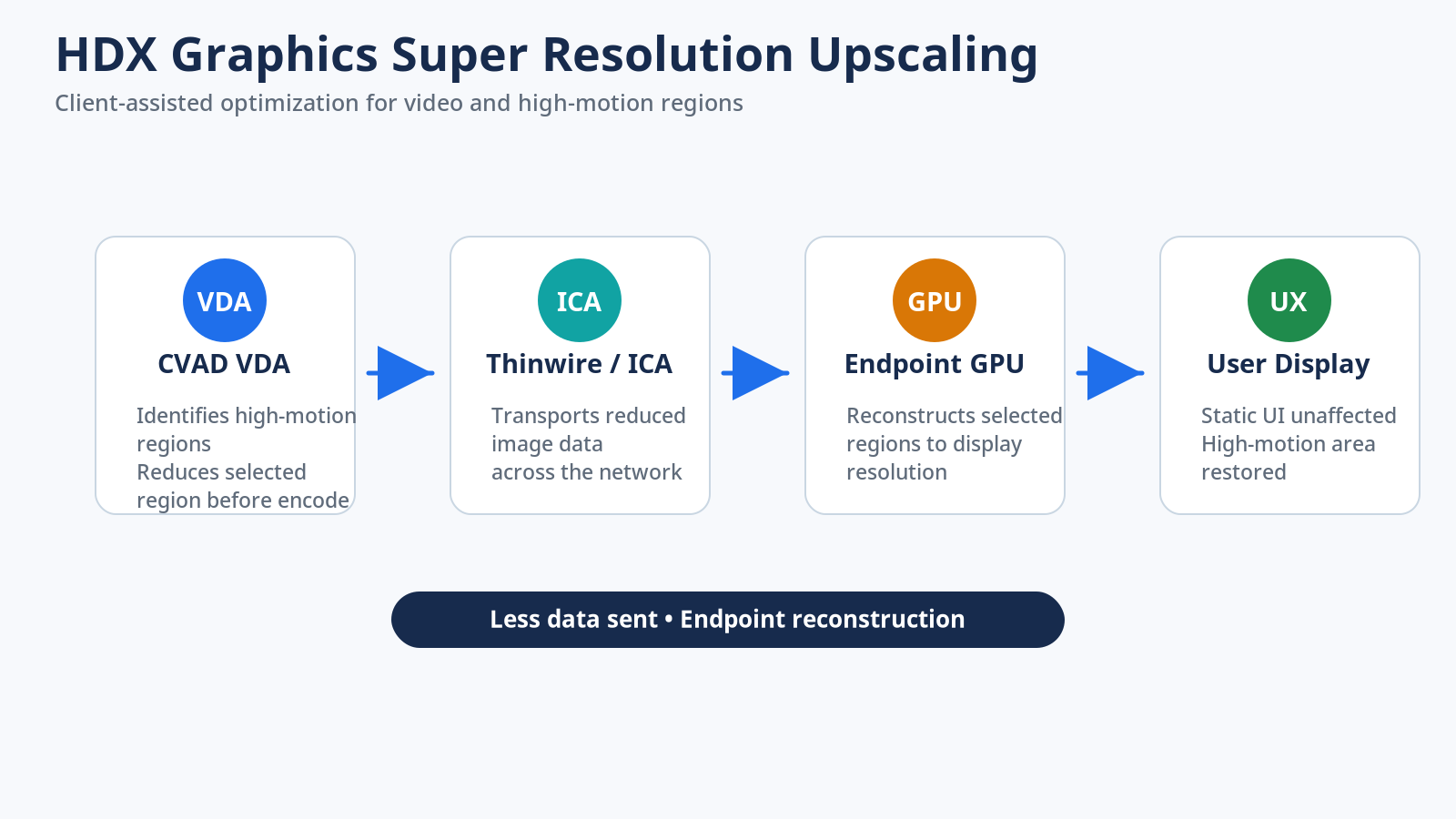
At a high level, HDX graphics super resolution upscaling (HGSRU) is designed to improve the efficiency of delivering video-rich and high-motion content within HDX sessions. Rather than transmitting transient content at its native resolution, it selectively downscales those regions on the Virtual Delivery Agent (VDA) before transmission. Once received by the endpoint, supported GPUs reconstruct the image using super resolution techniques to restore the content to its intended display resolution.
While historical solutions remain relevant, HGSRU introduces an additional optimization model that leverages modern endpoint hardware to reduce the amount of data transmitted across the network. By reducing the amount of video data that must be encoded, transmitted, and decoded, HGSRU helps improve delivery efficiency while maintaining the expected frame rate and image quality.
Importantly, this feature is not intended to enhance static desktop content such as text, menus, or application controls, and traditional Thinwire optimizations remain highly effective for those scenarios. Instead, HGSRU focuses specifically on dynamic regions of the display.
How It Works
At a conceptual level, HGSRU introduces an additional processing step into the delivery of transient content within an HDX session.
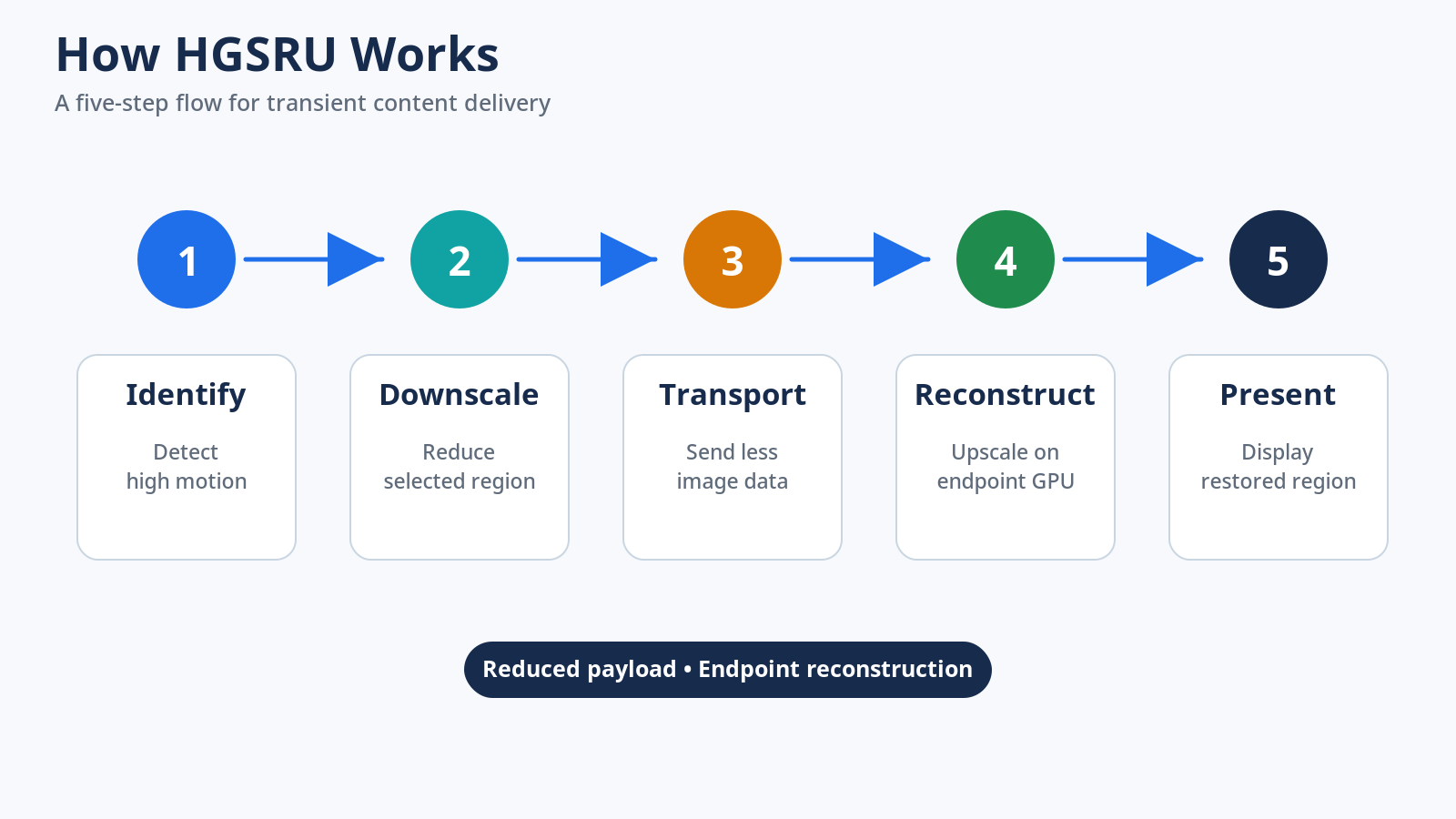
The process begins when HDX identifies regions of the display exhibiting rapid frame changes, commonly referred to as transient content. These regions may include embedded video, animated visualizations, or other dynamic graphical elements that would traditionally require a larger amount of data to be transmitted to the endpoint.
Rather than transmitting this content at its native resolution, the VDA selectively downscales the identified regions before they are encoded and transported within the ICA session, thus reducing overall bandwidth requirements associated with the workload. Once the content reaches the endpoint, a supported GPU performs the super resolution reconstruction process, restoring the image to its intended display resolution before presenting it to the user. This approach allows the endpoint to participate in the graphics pipeline, leveraging modern client hardware to improve delivery efficiency while maintaining visual quality.
This is transparent from the user’s perspective: applications function normally, workflows remain unchanged, and no user interaction is required. HDX simply determines when super resolution can be applied and leverages available endpoint resources accordingly. At a high level, the workflow can be summarized as:
- HDX identifies transient content.
- The VDA downscales the selected region.
- Thinwire transports the reduced image data.
- The endpoint GPU reconstructs the image using super resolution techniques.
- The reconstructed image is presented to the user.
Why It Matters
At first glance, HGSRU may appear to be a graphics enhancement feature. In reality, its primary value lies in improving the efficiency of delivering transient content within HDX sessions.
HGSRU introduces another option beyond traditional solutions. By downscaling transient content on the VDA before transmitting and reconstructing it on supported endpoint GPUs, it reduces the amount of data that must be encoded, transmitted, and decoded during a session. The result is a more efficient delivery model for video-rich workloads.
During testing, Citrix observed bandwidth reductions approaching 50% in certain full-screen video playback scenarios (results will vary depending upon workload characteristics, display resolution, endpoint hardware, and network conditions).
Beyond reducing bandwidth consumption, the primary objective of HGSRU is to maintain frame rate, session responsiveness, and perceived image quality. In many environments, user experience is ultimately determined by session interactivity. A responsive application with smooth visual updates is often more important than delivering every pixel at its original resolution.
Early testing has also demonstrated that endpoint GPU utilization typically accounts for only a fraction of the available graphics resources. Ultimately, HGSRU is about delivering transient content more efficiently while maintaining the experience users expect, and represents an important new capability.
From Feature to Platform Capability
What I find most interesting about the feature is not the upscaling technology itself, but rather where the capability appears to be heading.
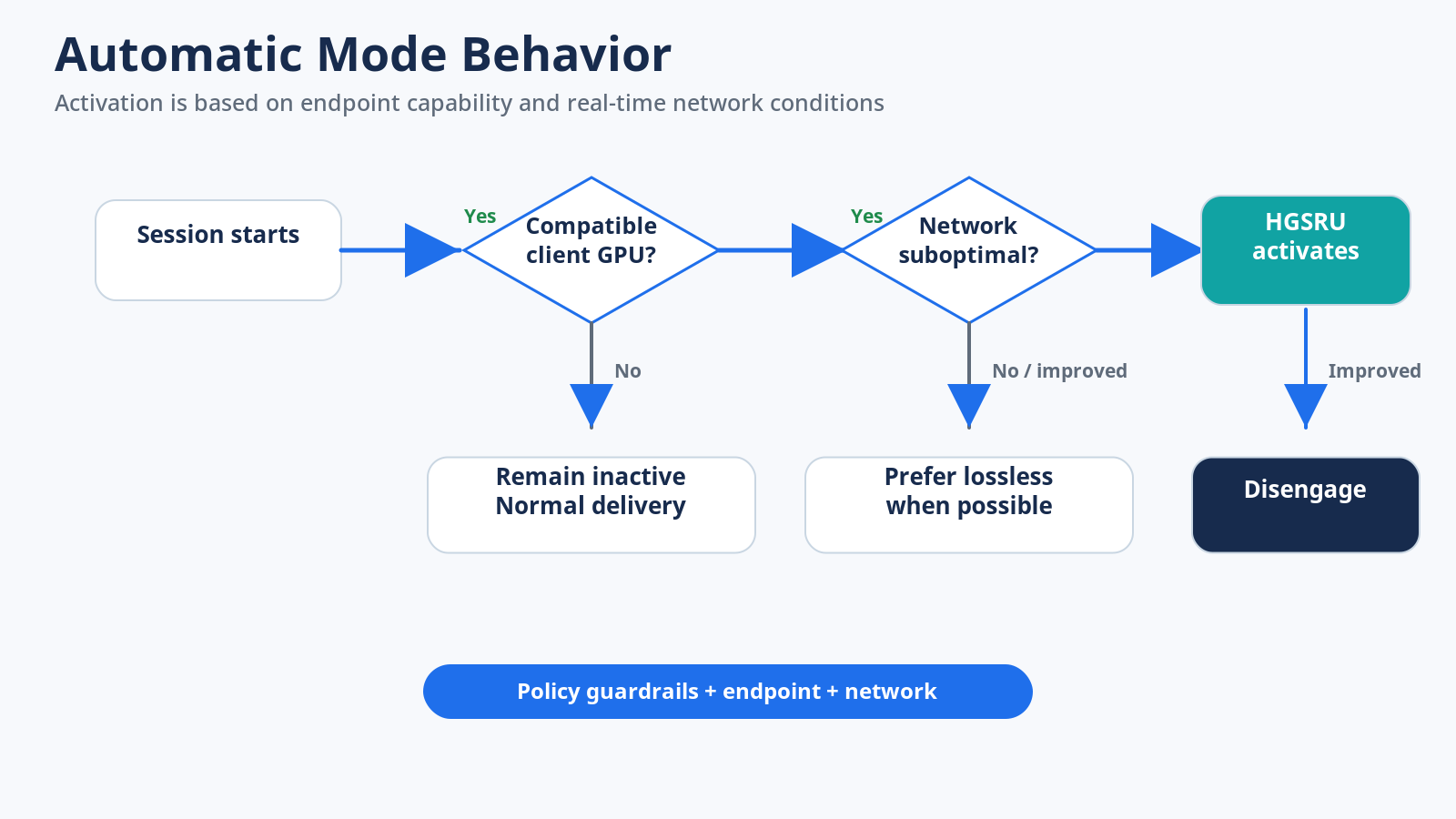
HGSRU introduces a new model that, in many ways, reflects a broader evolution within HDX. Rather than relying solely upon static policy configuration, HDX is increasingly capable of making intelligent decisions based upon real-time conditions. Administrators continue to retain control through policy, while day-to-day session optimization becomes more dynamic and responsive.
This is significant because modern EUC environments have become increasingly diverse. Designing static policies that anticipate every possible scenario becomes increasingly difficult. Features such as HGSRU help address this challenge by allowing the protocol to adapt automatically when conditions warrant.
Potential Use Cases
One of the more interesting aspects of HDX graphics super resolution upscaling is that its effectiveness is largely determined by workload characteristics; specifically, environments wherein transient content represents a meaningful portion of the user experience.
Financial Services and Trading Platforms
Financial services applications frequently combine traditional business interfaces with dynamic content such as live market data, streaming financial news, and rapidly updating visualizations. In these environments, users often require both low latency and high levels of session responsiveness.
Engineering, Geospatial, and Energy Workloads
Many engineering and geospatial applications contain a mixture of static controls and dynamically rendered content. Whether visualizing geological survey data, monitoring operational systems, reviewing mapping information, or interacting with engineering models, these workloads frequently generate transient content that can place additional demands on the remoting protocol. These scenarios often combine highly interactive application workflows with significant visual complexity.
Multimedia-Rich Enterprise Applications
Increasingly, enterprise applications incorporate embedded video, animated dashboards, and real-time data visualizations directly into the user interface. In many cases, these applications do not lend themselves to technologies such as Browser Content Redirection because the dynamic content is embedded directly within the application itself. HGSRU is well suited to these hybrid workloads.
Important Considerations
While HGSRU introduces exciting new capabilities for optimizing transient content, it is important to understand where the feature fits and where it may not be appropriate.
Endpoint Hardware Matters
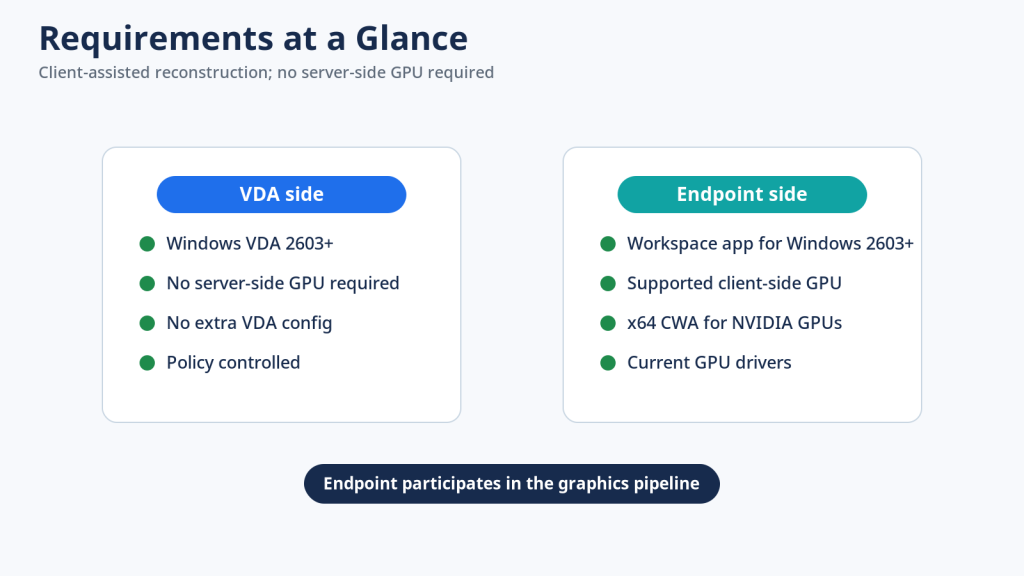
Unlike many traditional graphics optimizations that focus primarily on server-side resources, HGSRU relies on supported endpoint GPUs to perform upscaling; endpoint capabilities are a key consideration.
Factors such as GPU architecture, available graphics memory, and current GPU utilization can influence whether super resolution is available for a particular session. Fortunately, HDX performs these capability checks automatically and will only enable the feature if/when the endpoint can support it.
Not Intended for Pixel-Perfect Workloads
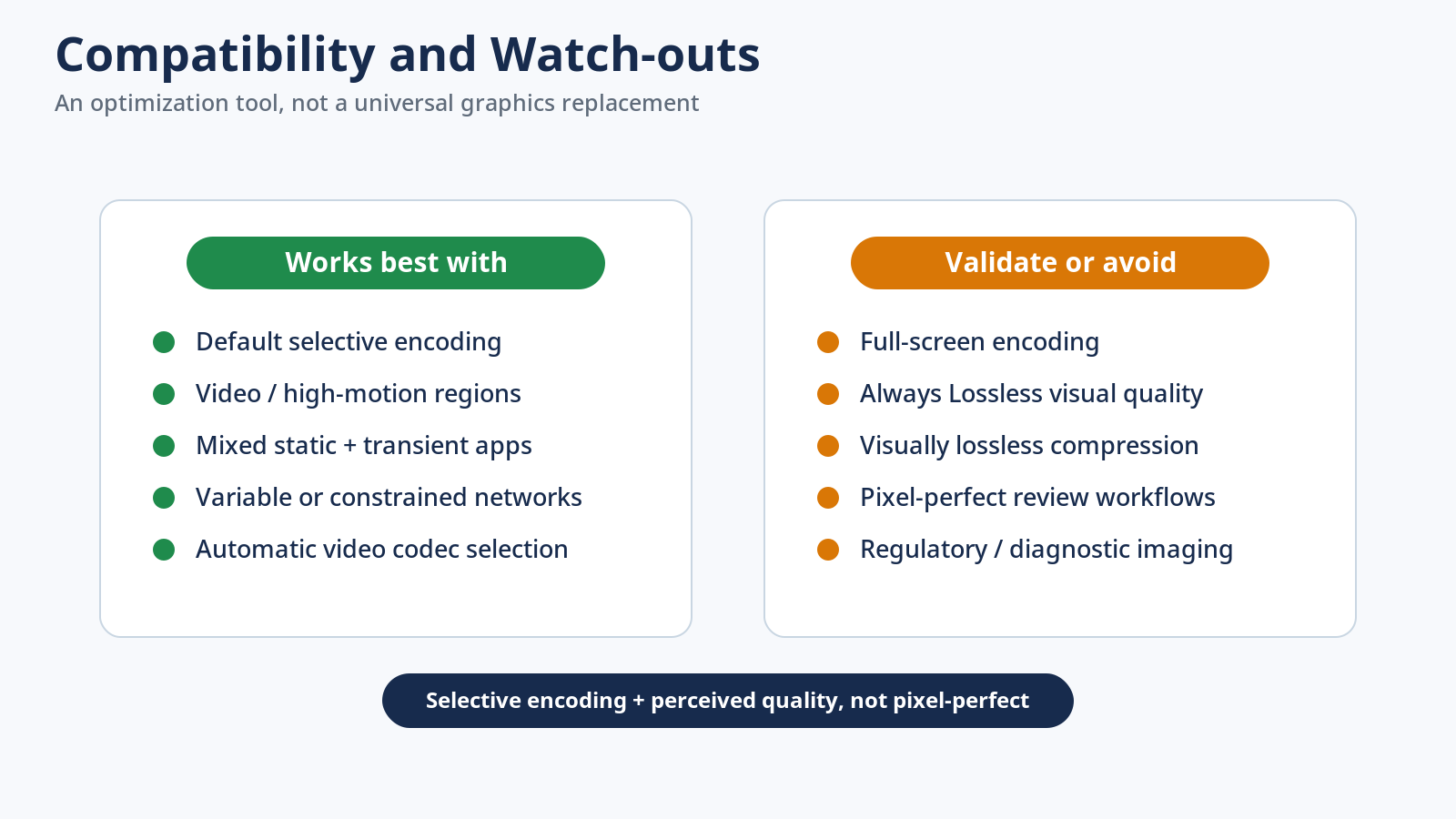
One of the more important caveats discussed during our conversations with the Citrix product team concerns image fidelity requirements: HGSRU is designed to maintain perceived image quality while reducing bandwidth consumption, though it is not intended to provide pixel-perfect image reproduction.
For workloads in which absolute visual accuracy is required (e.g., medical imaging or diagnostic applications), administrators should carefully evaluate whether the feature aligns with these requirements.
Measure the Right Outcomes
When testing HGSRU, it is important to focus on the metrics that matter. While bandwidth reduction is often the headline, the broader objective is to maintain a high-quality user experience under varying network conditions. Organizations should evaluate:
- Session responsiveness.
- Frame rate consistency.
- User perception of image quality.
- Bandwidth utilization.
- Endpoint GPU utilization.
A New Tool, Not a Universal Solution
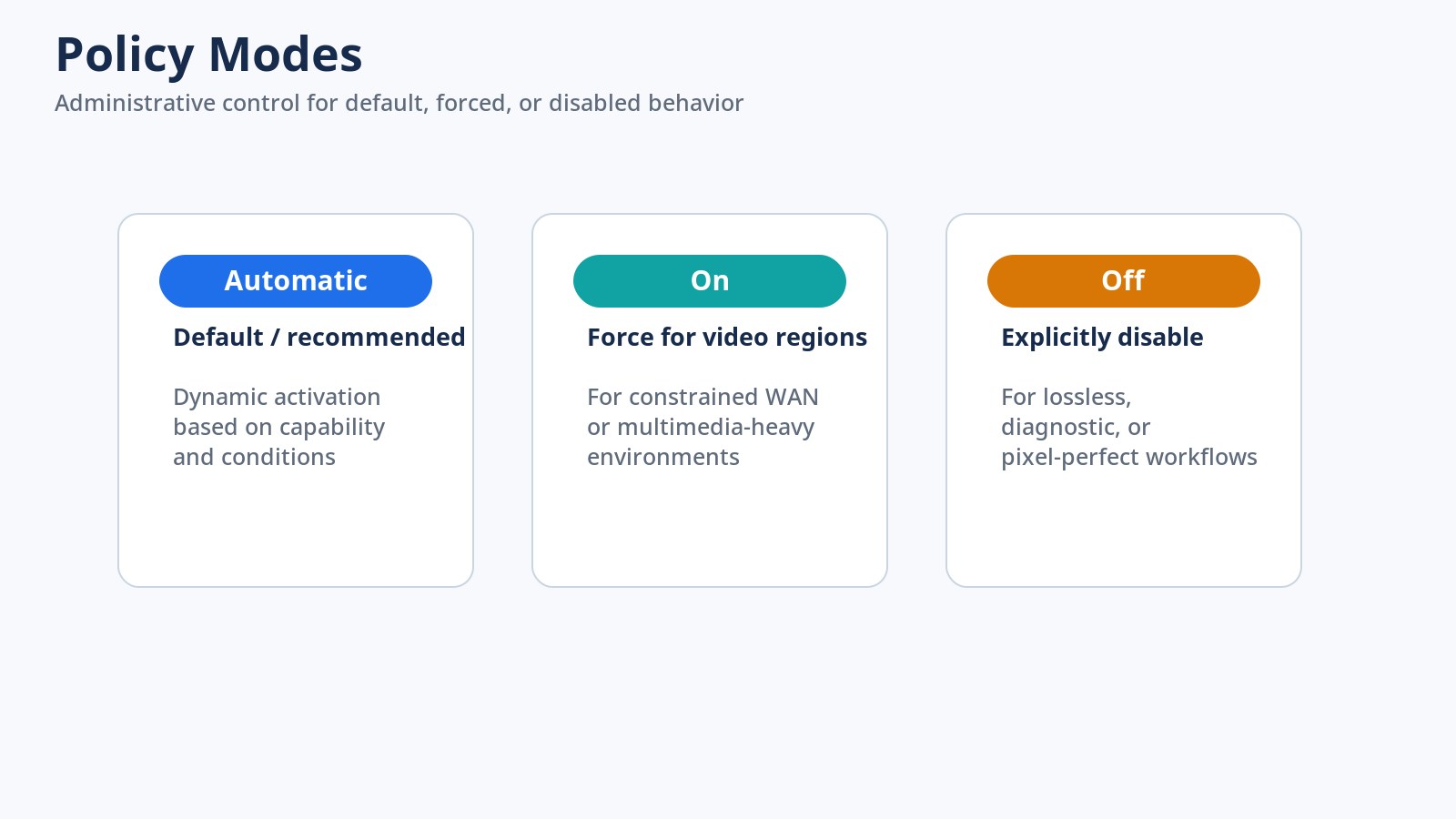
Perhaps the most important consideration is that HGSRU should be viewed as an additional optimization tool, but it does not replace existing graphics technologies, Browser Content Redirection, server-side GPU acceleration, or traditional HDX graphics policies. Instead, it introduces another option to optimize the delivery of transient content while balancing bandwidth consumption, image quality, and infrastructure efficiency.
Looking Ahead
HGSRU represents a different direction, in which Citrix has introduced policy-driven automation that enables HDX to make intelligent decisions based on endpoint capabilities and real-time network conditions. Rather than relying solely upon administrator-defined settings, HDX can dynamically determine when super resolution should and should not be applied, and how best to optimize the user experience for the conditions present during the session.
Looking ahead, support for additional endpoint hardware platforms, expanded policy controls, and deeper integration with the broader HDX graphics stack will continue to increase feature relevance across a wider range of environments. While the specific implementation details will evolve over time, it is clear that HDX is becoming increasingly adaptive, intelligent, and capable of optimizing itself based upon the conditions it encounters.
Ferroque Systems has decades of experience helping organizations across a range of industries and sizes to design, deploy, and manage Citrix solutions. If you’re evaluating HDX graphics super resolution upscaling or planning a broader modernization initiative, reach out to our experts. We would be happy to help.
Acknowledgements
I’d like to extend my sincere thanks to Eltjo van Gulik and the broader HDX engineering team at Citrix for their openness and willingness to engage throughout the development of this article. Having the opportunity to discuss HDX graphics superresolution upscaling while it was still in Tech Preview, understand the design decisions behind it, and follow its evolution through to general availability provided a level of insight that simply isn’t possible through documentation alone.
Congratulations to Eltjo and everyone involved in bringing the HDX graphics super resolution upscaling feature to market. Delivering a feature of this nature requires vision, engineering excellence, extensive testing, and a willingness to listen to customer and partner feedback throughout the development process. I have no doubt this capability will become another valuable tool for Citrix architects, engineers, and administrators as they continue to optimize user experience, bandwidth efficiency, and infrastructure investment across increasingly diverse EUC environments. It has been a privilege to follow the feature’s journey from its earliest preview discussions to its release, and I’m excited to see how the Citrix community puts it to work.


